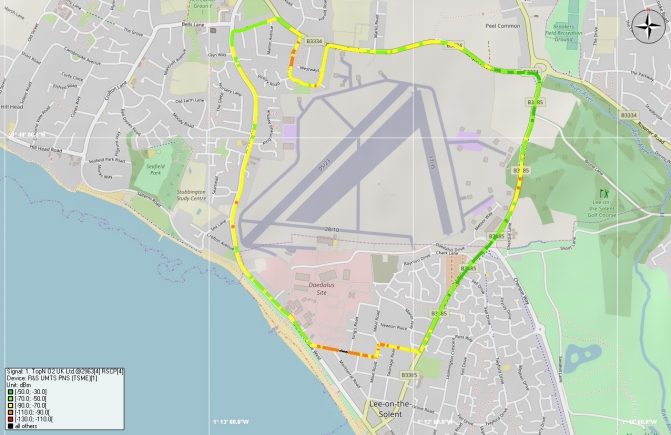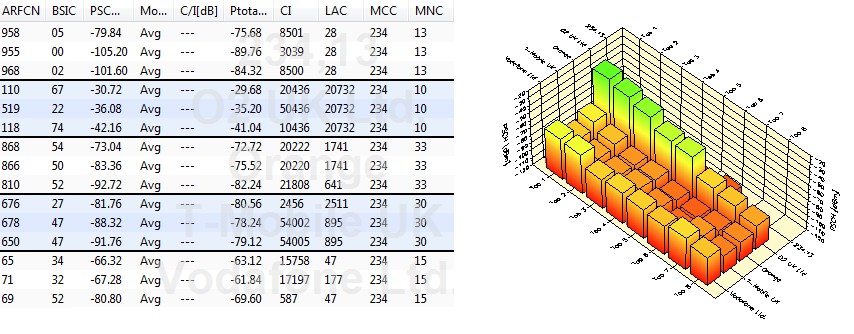
We undertake unbiased mobile network reception surveys to quantify the performance of existing and likely coverage in and around proposed development, existing buildings, indoor and outdoor locations. Assessment of the likely impacts upon mobile phone coverage and mobile network operations from wind turbines, wind farms and other structures can also be undertaken. Such surveys can be used to accompany planning application submissions, discharge planning conditions or to enhance a building’s WiredScore Certification. Our survey equipment measures all key performance indicators of a 2G, 3G, 4G or 5G network, not just the signal strength of the best serving cell, which provides only a limited performance indication. We also conduct automated high resolution in-building surveys with advanced mobile network signal receiving and processing hardware. Such surveys can be used to determine internal mobile network coverage, identify network coverage problems and to gain an understanding of signal penetration (or attenuation) through different building materials. Ofcom research undertaken in 2014 found; Broadly, building loss increases with frequency, i.e. higher frequency signals will experience a greater reduction in signal strength when passing through an object than lower frequency signals. This is the reason why lower frequencies are preferred for delivering wide area and in-building coverage for mobile networks; and The use of common materials such as foil-backed plasterboard and metallised double-glazing has a tangible effect on in-building coverage. On average, the presence of these materials reduced the strength of incoming signals by between 6 and 11 dB, compared to standard wall construction and single glazed windows.
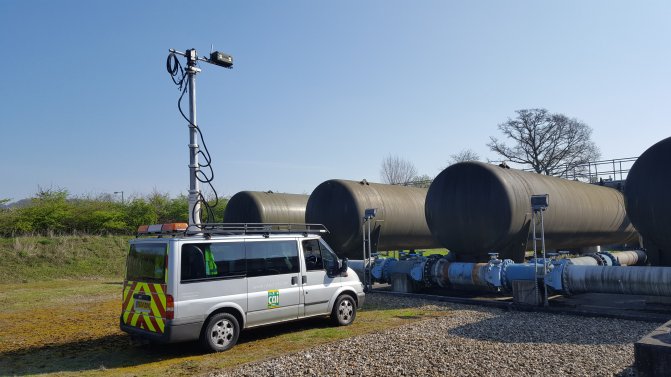
All mobile network surveys are undertaken using advanced radio signal processing hardware with Rohde & Schwarz TSMA equipment and signal processing software from Rohde & Schwarz ROMES, providing network owners with detailed analysis of network performance and coverage. Reception testing can also be undertaken up to 13m AGL using survey vehicles and masts. Thames Water utilised this survey system between 2017 and 2023 to verify elevated 2G, 3G and 4G network coverage at several water pumping stations.
2G networks (2G, 2.5G and 2.75G – GSM / GPRS / EGPRS / EDGE Evolution) are mainly for voice services and slow data transmission. These are classed as Global System for Mobile Communications (GSM) networks. GSM networks have been deployed worldwide as second-generation mobile communications systems. GSM originally was developed to transmit voice, but it is also able to transmit data with a maximum load of 9.6 kbit/s in the downlink and uplink. While historically old technology, it is robust and well tested. GSM / GPRS technologies are now vitally important for the Internet of Things future. In the UK there are three 2G networks; Everything Everywhere (EE was formed by the merger of Orange and T-Mobile), O2 and Vodafone.
3G networks (3G, 3.5G and 3.75G – WCDMA / HSPA / HSPA+ / DC-HSPA+) find application in wireless voice telephony, mobile Internet access, fixed wireless Internet access, video calls and mobile TV. These are classed as (Universal Mobile Telecommunication System (UMTS)) networks and are based on wideband code division multiple access (WCDMA) technologies. They have been deployed worldwide as 3rd generation mobile communications systems. By the end of 2025, it is expected that all 3G networks in the UK will have been shut down.
4G, short for fourth generation, is the fourth generation of mobile telecommunications technology, succeeding 3G and preceding 5G. Long Term Evolution (LTE) will ensure the competitiveness of UMTS for the next ten years and beyond by providing a high-data rate, low-latency and packet-optimised system. LTE can be operated in either frequency division duplex (FDD) or time division duplex (TDD) mode, also referred to as LTE FDD and TD-LTE. A 4G system, in addition to the usual voice and other services of 3G, provides mobile ultra-broadband Internet access, for example to laptops with USB wireless modems, to smartphones, and to other mobile devices. Applications include enhanced mobile web access, IP telephony, gaming services, high-definition mobile TV, video conferencing and cloud computing. 4G networks are provided by EE, Three, O2 and Vodafone.
5G is the fifth generation mobile network. It is a new global wireless standard after 1G, 2G, 3G, and 4G networks. 5G New Radio (NR) enables a new kind of network that is designed to connect virtually everyone and everything together including machines, objects, and devices. 5G wireless technology is meant to deliver higher multi-Gbps peak data speeds, ultra low latency, more reliability, massive network capacity, increased availability, and a more uniform user experience to more users. Higher performance and improved efficiency empower new user experiences and connects new industries.